Showing posts with label Reading Notes. Show all posts

Tuesday, November 15, 2016

Reading Notes: Jataka Tales, Part A

These are from the Jakata Tales by Ellen C. Babbitt

How the Turtle Save His Own Life: I liked this story because the turtle is portrayed as a clever animal. I have not read many stories about turtles, but I liked that in this story he was portrayed positively. In this story, there is a father who wishes for his children to murder this turtle. The turtle begs the boys not to throw him into the river. In reality, the turtle knows that the water is a safe place for him so he is tricking the boys. Once in the river again, he is safe!

The Turtle Who Couldn't Stop Talking: I have read different versions of this type of story in the past. Basically, the turtle wants some birds to take him on their journey. They carry a stick while he holds onto it with his mouth. He is warned not to talk, but does so anyways. This causes him fall from the air to his death. The moral is for those who cannot stop talking to keep their mouths shut, or they will be punished. I think it is an interesting message and one I do not think is always applicable. I decided to do notes on it because it showed a different message and portrayed turtles in a different light than the previous story I talked about.


Reading Notes: Russian Folktales, Part B

These are from the Russian Fairytales by W. R. S. Ralston

The Warlock: This story is about an old man, known to the village as a warlock, who gives his three daughter-in-laws orders for after his death. They are to look after him for three nights and that nobody should wear a cross in his wake. The first night, he wakes from his coffin and asks the daughter-in-law if she is there and spinning wool. She becomes so frightened that she doesn't answer and the man's ghost strangles her. The same thing happened to the second daughter. The third was smarter and wore her cross. When the ghost came after her the third time, she lays the cross on him and he falls dead. In his coffin, the family finds a ton of money that the father was wanting to take with him.

The Witch Girl: This is a story about a town with a strange and terrible custom. There is a witch girl who come around every night and the house she choses must have every member put themselves in coffins the next day, because they are to die. Basically, a man comes in and defeats this which and helps the chosen house survive.

I wrote about these stories because I thought they were sad and gruesome, like many other Russian Fairytales. I want to give one of these stories a happier ending in my retelling.


Reading Notes: Russian Folktales, Part A

These stories are from Russian Folktales by W. R. S. Ralston

The Dead Mother: I thought I would do notes on this story because it is not the typical type of story you think of when you hear "fairytale" or "folktale". It is about a mother who dies after having a baby. The baby cannot stop crying, except for at night. The family cannot figure out why, but they hear someone coming inside the house every night and the baby becomes quiet. The family stays up and catches the person...it is the mother's ghost coming in a breast feeding the baby overnight. It was a pretty grim story and not a typical one you would tell to your children, like you would other folk stories.


Friday: This story, I'm assuming, tell of the importance of disrespect. A woman disrespects Mother Friday and pays the price. Mother Friday comes in the middle of the night and shoves dirty into the woman's eyes so that she cannot see. The woman wakes up in a panic and begs Mother Friday for forgiveness. She is forgiven and gets her sight back, never disrespecting Mother Friday again. For me folktales and fairytales are those stories that you tell your children. This story was a little gruesome and cruel, in my opinion, for a child so I thought it was an interesting one to write notes about.


Monday, November 14, 2016

Reading Notes: Brothers Grimm (LibriVox), Part B

This story is from the Fairy Tales by Brothers Grimm

The Fox and the Horse: This story is about a horse who has become old. His owner turns away from him and says he (the horse) shall not return until he is stronger than a horse. Out in the wild, the horse meets a fox and he shares his story. The fox tells him that he can help him with becoming as strong as a lion. He tells the horse to stretch out on the ground and lie very quietly. In the meantime the fox goes and gets a lion and tells him he knows where he can come and find a horse. The fox ends up tricking the lion and ties all of his legs together. The lion freaks out and makes a ton of noise and the horse's owner can hear him roaring. He decides that the horse has done what he was supposed to and tells him he can stay in his stables forever. I really like this story and I am planning on using it for my story this week. I want to tell the story from the point of view from the fox. I plan to have him watching the horse and when he sees the rejection of the owner, he decides to try to help the horse. There are a lot of possibilities for the retelling of this story.


Reading Notes: Brothers Grimm (LibriVox), Part A

These are stories from the Fairy Tales by Brothers Grimm

The Straw, the Coal, and the Bean: This was a story involving three inanimate objects: a piece of straw, a piece of coal, and a bean. They have all escaped the wrath of a woman who was cooking and are looking to get away. On their escape mission, the piece of straw gets burned and the coal joins. The bean, who was much more cautious, laughs so hard at the others misfortune that he bursts into pieces. His luck allowed him to be sewn back together by a tailor who was passing by. As a result, all beans in the future would have a black seam. I thought I would do notes on this story because it seemed different from the other stories this week. It was not a normal fairy tale that I am familiar with so I thought it would be interesting to come back to on Wednesday when I write my story.

The Mouse, the Bird, and the Sausage: This story was about three things that come together and live in one single household. They each have certain jobs and do their work nicely. One day the bird realizes that he does much more work than the others so they decide to all change jobs. The sausage ends up getting eaten by a dog, the mouse gets burned by a log, and the bird ends up drowning. I would like to retell this story from the point of view of each animal after the jobs have been switched and leading up to their deaths.


Tuesday, November 8, 2016

Reading Notes: English Fairy Tales, Part B

These are from English Fairy Tales by Joseph Jacobs

Mr. Miacca: I liked this story because it reminded me of Hansel and Gretel. A little boy leaves his house, even though his mother tells him not to, and gets captured by Mr. Miacca who wants to eat him. The boy tricks Mr. and Mrs. Miacca and escapes only to get caught again when he sneaks out of his house. He figures out a way to escape and is good after this and does not leave his house. I thought it was an interesting story and I thought it was funny that there are stories in many cultures about little children getting cooked for supper.

Fairy Ointment: Dame Goody is a nurse who takes care of babies and sick people. A man comes to her one night saying that his wife needs her help. She came and helped this family and rubbed oil on the baby's eyes. This turned them all into fairies. The family paid Dame Goody more than ever before in her life. This story caught my attention because I have not read anything with pixies in it before. It was very different from many other stories I have read in the past so I really liked it.

Monday, November 7, 2016

Reading Notes: English Fairy Tales, Part A

This week I chose readings from English Fairy Tales by Joseph Jacobs

Binnorie: This is a very interesting story; one that stuck out to me from this weeks first reading. It is about a jealous sister who eventually drowns her sibling in order to get her love. After her death, someone finds her body and makes a harp out of her breast bone and hair. The harp sings and tells those that her sister drowned her and then the harp breaks. Jealousy is a cruel and powerful emotion that can drive people to do very crazy and unthinkable things.

Mouse and Mouser: This story kind of reminded me of the cartoon Tom and Jerry. A mouse is talking to a cat and telling him of how he went to market and bought some pudding. In the end the cat eats the mouse. It is told in a rhyme scheme that is very repetitive. I think it would be cool to tell the story in the same way but make it more humorous and have a happier ending...maybe one similar to a Tom and Jerry cartoon.


Tuesday, November 1, 2016

Reading Notes: Japanese Fairy Tales, Part B

The Crab and the Monkey by Andrew Lang: This is a story about manipulation and revenge. The monkey continually has the upper hand in his exchanges with a crab. The crab is even beaten by the monkey at one point. His friends help him to heal and they all plan an attack of revenge on the monkey. The monkey comes to make a half-hearted apology and finds himself stealing an egg from the crab. This backfires on him when the egg explodes, he gets stung by a wasp, and falls into a hole and dies. At the end it describes the crab living happily ever after and peacefully dying of old age. This was a sad story for both the crab and the monkey. If I were to retell it I think I would try to make it a little more upbeat.


Schippeiraro by Andrew Lang: This story was a little confusing, but I thought it was also quite interesting. It tells of a Japanese custom where boys are sent off when they become young men in order to find themselves and gain independence. This one young boy wonders and finds himself in a chapel where he decides to sleep. He wonders into the nearby village and becomes involved in something there. From my understanding, he takes this dog back to the chapel where the cats and their king are going to kill him. Instead of letting this happen, the boy and the other youth there cut off the cats head. This causes them all to be heroes and celebrated every year. If I were to retell this story I would make the people animals. I think it would be cool to tell of the animals journey before he finds himself in the chapel. It discusses how sometimes the men would chat and discuss their journeys, but other times these men would be robbers. It would be interesting to maybe make up a story about a robber and the man (animal).


Monday, October 31, 2016

Reading Notes: Japanese Fairy Tales, Part A

Japanese Fairy Tale Unit
The Violet Fairy Book by Andrew Lang

The Two Frogs: This story was about two frogs who wish to travel to each others towns. They meet in the middle and become friends. They decide to stand on each others shoulders in order to see the town they are traveling to. They are foolish and do not realize that they are looking at their own towns and decide to not travel any further. I thought this was an interesting and peculiar story. It would be interesting to do a retelling of it where they end up traveling to each others towns instead of turning around and returning home. I do not know much about Japanese culture, but I think it would be interesting to do some research on these towns and then write about the two frogs experiences and how they would differ from their home towns.


Reading Notes: Aesop's Fables Part A

From Aesop's Fables by Christopher Smart

These notes are from the chapter on foxes.

The Fox and the Grapes: This is a pretty famous story that I heard many times as a child. Essentially the fox cannot reach the grapes on a vine. As a result he concludes that the grapes are not ripe and that he will move on to a better place to find food. I like this story because I think it is easy to relate to the fox, even if we do not want to admit it. I think it would be fun to retell this story with a different ending...maybe have the fox find a way to reach the grapes instead of just giving up and walking away.

The Fox and the Goat: This story was a little harder to understand due to the language. From my understanding the fox falls into a well and is trapped. A goat comes along and the fox coaxes him into the well. From here he uses the goat to climb on and escape the well. This is another story that exemplifies how foxes are cunning and use others in order to get their way. I think it would be interesting to tell this story from the goat's perspective.

The Fox and the Eagle: I liked this story because it is not a typical fox story. Instead of being the cunning trickster, the fox is the one who is preyed on. Her children are stolen by an eagle, intended to be fed to her young eaglets. The fox is desperate to get her children back. I think it would be interesting to tell this story as is, but then have this be the reason why foxes become so cunning. Maybe they have to be in order to keep themselves and their families safe.


Tuesday, October 25, 2016

Reading Notes: Alaska, Part B

The Ghost Land by Katharine Judson: This story was very peculiar and strange. I have found that many of the Alaskan Indian tales are sad and include death. This story in particular is about the wife of the chief's son that died. He goes to ghost land and finds her and brings her back, but others can only see her shadow. I think this could represent the fact that when a loved one dies we still see them everywhere. We are reminded of them in our everyday lives and it is easy to still picture them being with us. For others, they may only see the shadow, not the full picture.

The Boy in the Mood by Katharine Judson: This story is how the sun and the moon came to be and how they rotate about the world. A boy was in love with a girl and tried to follow her into the sky. He was unable to keep up though and so he became the moon and she became the sun. When he began to fade, she would feed him and make him whole again. This story seems to be about how a woman provides for a man, instead of the other way around which I thought was interesting.


Monday, October 24, 2016

Reading Notes: Alaska Part A

These stories are from a collection of Native American folktales. I chose to do the ones focusing on Alaska. My brother traveled her a few years ago and loved it so I thought it would be cool to learn some of its native history through its stories.

The Origin of the Tides by Katharine Judson: As the title discusses this is a story of how the tide came to be. Qa, the Raven, built a house under a rock and twice a day someone would open and close a door causing the tide to go in and out. Then the stories discusses a man who goes out into the waters and is affected by the tide. The tide is something that will forever confuse me so I thought it would be interesting to somehow incorporate this story into one of my own where I can make the tide make sense.


Raven's Feast by Katharine Judson: This story was quite interesting to me. It told of how everyone followed what Raven did. When he had a feast, so did everyone else. When he had fancy hats, others followed. This story helps to tell of how people felt about others and how respect was of great importance in Indian tribes. Even if things may have seemed excessive, wasteful, crazy, etc., if you respected the person and were to follow what they did, then you did just that.


Monday, October 17, 2016

Reading Notes: Tejas Legends Part B

Why Hummingbirds Drink Only Dew by Florence Stratton: This story kind of reminded me of the tortoise and the hare. The hummingbird is too confident and loses a bet to the heron that he can fly faster across the lake. The heron can see at night so he ends up winning the race. As a result, the hummingbird can never drink water from a lake again. I think it would be cool to retell this story with people. I could have them race across land and have one man do something clever that causes him to win.


How Sickness Entered the World by Florence Stratton: Once, there was no sickness in the world. As the medicine man was dying, he told two men to go wait for the great spirit to come impart knowledge on them. As they waited, a snake appeared so they killed it and went to tell the medicine man. The snake was actually the great spirit and as a result many people in the camp were cursed and sickness would strike them and then their ancestors. This was an interesting story because it used aspects of indian culture (spirits, wigwams, medicine men) and also things that are very common in texas (snakes).


Reading Notes: Tejas Legends Part A

I decided to write from the Tejas Legends because I am from Texas. I thought it would be interesting to read stories that originated in my home state.

The Plant That Grows in Trees by Florence Stratton: This is the story of how/why mistletoe grows on trees and not on the ground. A quick synopsis is that once, a thunder bird ate the berries from this plant. It learned that doing this killed the plant. The bird decided to pick up the mistletoe and put it up in a tree where other animals could not get to it and break it. When the birds wiped their mouths after eating the plant, the seeds would stick to it so that it could again grow. I liked this story because it was different from many others I have read. I liked that the plant had dialogue and could converse with the bird. I also like that the bird took pity on the plant. I think it would be interesting to tell if from the point of view of the mistletoe. Maybe the plant is wondering why it grows up in a tree and its mother could tell it the origins of its location change.

The Woodpecker's Stumpy Tail by Florence Stratton: This story tells why the woodpecker has such a stumpy tail. A long while ago it used to have a normal long one. There was a flood and all the animals were warned. The woodpecker did not take it seriously and was left jumping from branch to branch when the storm hit. He could not get high enough and a fish came and bit his tail off. I think it would be cool to tell this from the point of view of the fish. He could have thought this flood would be great because it would mean more water, but really it just washed all of his normal food away and his only option was the bird's tail.


Tuesday, October 4, 2016

(Extra) Reading Notes: Folklore of Laos, Reading A

A Child of the Woods by Katherine Fleeson: A woman tells of how she became revered by all. She once lived in a village but became overwhelmed with anger so she had to leave. She lived in the forest and was respected by the animals and her heart grew less angry. She went to a village and told the people how the animals respected her and she was not afraid of them. They were in awe of her and were amazed. This story kind of reminded me of the Jungle Book so I really enjoyed it. I think it would be neat to retell it from the point of view of one of the animals

The Mountain Spirits and the Stone Mortars by Katherine Fleeson: Stone mortars are brought to the city and the people are told to buy them, but the people complain that they have no use for them and that they are far too expensive. The spirits told the people that they needed to carry them back up the mountain if they don't want them. The people know this is impossible so they just pay for them. An interesting aspect of this story is that they emphasize that obviously this is the true story of what happened because you can still see that the mortars are scattered about the city. I think it would be interesting to retell the story and have someone or something else move the stones into the city and since the people don't know who it was they just assumed it was the spirits.


Reading Notes: Tibetan Folk Tales Reading B

These are from the Tibetan Folk Tales by A.L. Shelton

How the Rabbit Killed the Lion: There is a lion who is king of all beasts. A rabbit decides not to go kowtow (what I am guessing means something like praise) the lion because he was too comfy in the grass. The lion sees him and asks why he did not come. The rabbit makes up a lie so that he is not killed and says that a she-devil came and scared her silly and that the lion should go down to the water to talk to her. He does so with much pride; when he looks into the water and sees his reflection, the rabbit exclaims that the reflection is the she-devil. The lion freaks out and pounces into the water and eventually drowns himself. This shows an important message about pride and ego. The rabbit is very clever and outwits the lion.


The Three Hunters: This is a very gruesome and brutal story. Basically, there are three hunters, their three wives, and their one sister. The wives are jealous of the sister so the older two wives kill her. Her soul is transformed into a bird and the brothers find out. The younger wife eventually tells the hunters what happened and they end up killing the older two wives. I wrote about it because it was a very straightforward story and there was not a lot of interpretation to it which is different than most stories. Also this story contained no animals as characters which is different than a lot of the other Tibetan stories.


Monday, October 3, 2016

Reading Notes: Tibetan Folk Tales Reading A

These stories are from the Tibetan Folk Tales by A.L. Shelton

The Man and the Ghost: This story was a very interesting read. It is about a man who meets a ghost and they make a mutual agreement to help each other out when they can. They go into town and the ghost steals the soul of the king's son and puts it in a sack and gives it to the man. When the man hears that the king's son is ill, he goes to him with the sack and says he can heal him. In return the king offers him a great fortune. The man releases the king's son's soul and does a type of ritual around the boy and "cures him." If I were to retell this story I would do it from the point of view of the king to show his side of the story.

The Story of the Donkey and the Rock: This story starts out with a king who is very fair and just and loved by the people. In the same land are two poor men to work very hard and care for their mothers. One day the two men are passing each other and one man's donkey hits the other man's cart causing his expensive oil he was going to sell to fall and crash on the ground. They went to the king, but he blamed it on the donkey and the rock, not on either man. The people from the city came to see this trial of the donkey and the rock and the king somewhat chastised them for coming and told them they each had to pay half a cent for doing so. He then gave this money to the man for his spilled oil. I liked this story because it shows many different morals. If I were to retell this story I think it would keep most of it the same, but maybe tell it from the point of view of one of the poor man's children that he would eventually go on to have. Or maybe someone was healed by that oil and it could be from their point of view.

Monday, September 26, 2016

Reading Notes: Nigeria Part B

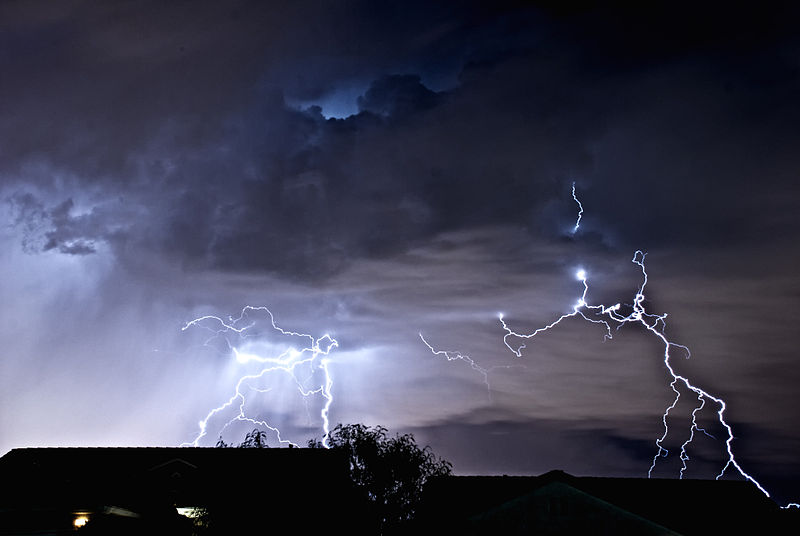
The Lightning and the Thunder by Elphistone Dayrell: This story is about how the lightening and thunder came to be a part of the sky. Originally they were here on earth. Thunder was lightening's mother and when lightening would act up and burn things down, thunder would rebuke him. Lightening could not control himself so they were both banished to the sky. I liked this story a lot and if I were to retell it I would maybe try to change the elements and do wind or rain just to change things up.

Lightening wikimedia

Why the Moon Waxes and Wanes by Elhpistone Dayrell: In this story the moon is a round and jolly creation. She comes down to feed a poor old starving woman and in return she cannot give as much light as before. The people are angry that she is not giving off light and scare her back into the sky. From that time forward, she goes from being round and plump and giving lots of light to being very skinny just like when she would feed the old woman. If I were to choose this story I think I would try to give a happier ending where the people appreciated what the moon was doing, or maybe change it altogether and make up a story of how the sun came to be so bright because the moon was unable to do the job during the night. 

Reading Notes: Nigeria Part A

Why the Bat Flies at Night by Elphinstone Dayrell: This story was very interesting and one of my favorites this week. It is the telling of how the bat came to be nocturnal. He had told his friend, the rat, how to make soup especially delicious: by boiling himself in the water. When the rat tries to do the same, he dies. As a result everyone tries to catch the bat, but he hides in his bush and only comes out at night. I enjoy tales where the end comes to a conclusion about something that is true of that animal...like how the bat has to now hide and that is why he is nocturnal. This is a very tragic story because the bat had no intention of killing the rat, but it makes for an interesting story.

Why a Hawk Kills Chickens by Elphinstone Dayrell: This story was pretty gruesome and tragic as well, but it is another story that explains animal behavior so I chose to write notes on it. Basically the hawk is able to kill the chickens because once upon a time the chicken that was marrying a hawk was too poor to pay her dowry to him. As a result, the king said that the hawk could kill any chicken and have no consequences. I like that these Nigerian stories are used to explain things that we see animals do today. I also see the trend that their stories are a bit brutal and sad. 

Hawk Wikimedia

Tuesday, September 20, 2016

Reading Notes: Bidpai Part B

The Hare, the Fox, and the Wolf by Maude Barrows Dutton: This story is not the usual animal fable that sends a direct message. The hare outwits the wolf by saying that he can get him a better meal. He leads him to the fox and tells the fox that someone is wanting to meet him. The fox is too smart and knows its a trap so he sets his own to catch the wolf. When the wolf and the hare enter, they are trapped and the wolf devours the hare. I like that this story has somewhat of a twist and that the fox outwits the other animals. I feel like a lot of the time, the fox thinks he is being cunning, but then ends up in trouble. If I were to use this story I think I would change it so that the fox is much more cynical and narcissistic and believes the hare and falls victim to the wolf. 

Wolf Wikimedia

The Crane and the Crab by Maude Barrows Dutton: I chose to write about this story because I have yet to read an animal story that includes the crab. I was unsure how this animal would be portrayed. I like the idea that the crane was trying to use his wit and manipulation techniques to survive...I think this could be a very interesting retelling. If I were to chose this story, I would use people and show them that greed and manipulation will not lead to anything good.